
What Is Performance Marketing? A Beginner-to-Advanced Guide (2026)
Introduction
Every rupee you spend on marketing should be traceable to a result. That’s the baseline expectation in 2026. Performance marketing is built entirely around this idea — paying for outcomes like clicks, leads, and sales, not for reach that goes nowhere. If you’re a business owner in India trying to understand where your budget actually goes, this guide will give you a clear, practical answer.
What Is Performance Marketing? (Clear Meaning)
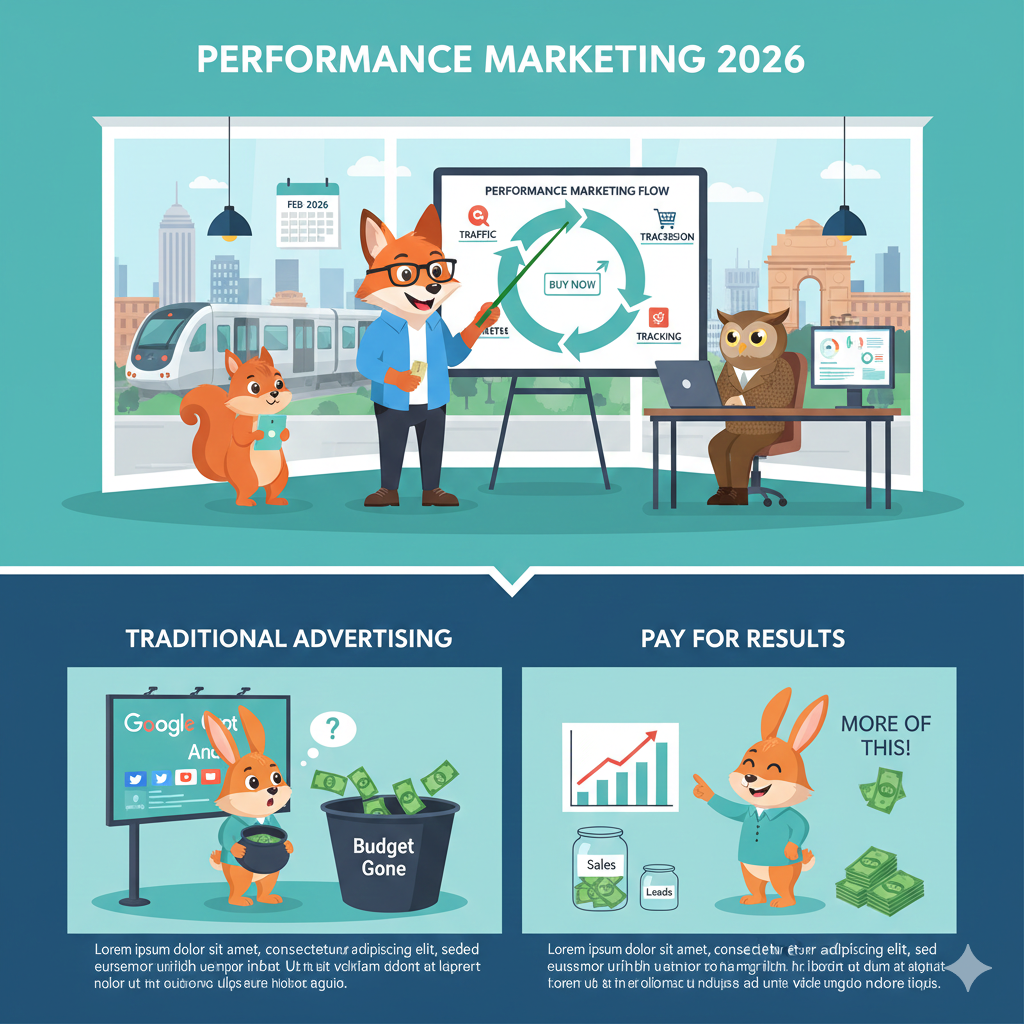
Performance marketing is a model where you pay only when a specific action happens — a click, a form submission, a purchase. Traditional advertising is like renting a billboard: you pay whether anyone looks or not. Performance marketing is closer to hiring a salesperson on commission. You pay when they deliver.
At its core, performance marketing meaning is simple: accountability tied to measurable results. No guessing, no hoping. Every rupee is linked to a trackable outcome.
How Performance Marketing Works (Practical Flow)
The process isn’t complicated, but most businesses get stuck somewhere in the middle:
1. Traffic — Someone finds your ad or content. A Google search, a Meta ad, or an organic click from SEO.
2. Conversion — That visitor takes an action you care about: buying, filling a form, downloading something. This is the moment that matters.
3. Tracking — The system records what happened and connects it back to the exact source — which ad, which keyword, which platform.
4. Optimization — You look at what worked, cut what didn’t, and test new ideas. More budget to the winners. Repeat.
This loop runs continuously. It’s not a one-time setup — it gets sharper over time.
Key Performance Marketing Channels
Not every channel works the same way, and not every business needs all of them. Here are the performance marketing channels that actually deliver:
Google Ads is strongest when someone is already searching for what you sell. You’re not interrupting them — you’re answering a question they asked. For intent-driven businesses, this is usually where to start.
Meta Ads (Facebook & Instagram) works best for creating demand. People aren’t searching for your product yet, but you can put it in front of the right audience. Meta remains dominant in India where social usage is high.
SEO as a performance channel is often overlooked. When you optimise for buyer-intent keywords, SEO becomes a direct performance driver — not just a vanity metric.
Affiliate and influencer performance models are growing fast. Instead of a flat fee for a sponsored post, you pay only when their audience converts. This turns influencer marketing into a true performance play.
Performance Marketing KPIs That Matter
Here are the five performance marketing KPIs that actually tell you whether your campaigns are working:
| KPI | What It Means | Why It Matters |
|---|---|---|
| CPA (Cost Per Acquisition) | Cost paid per new customer or lead | The true cost of acquiring one customer. Lower is better — if quality holds. |
| ROAS (Return on Ad Spend) | Revenue earned per rupee spent on ads | The key e-commerce metric. A 4x ROAS = ₹4 earned for every ₹1 spent. |
| CTR (Click-Through Rate) | % of people who click after seeing your ad | A low CTR signals your creative or targeting needs work. Early warning sign. |
| CAC (Customer Acquisition Cost) | Total marketing spend ÷ new customers | Broader than CPA — covers all channels, not just one. |
| LTV (Lifetime Value) | Total revenue one customer brings over time | Justifies higher acquisition costs. Repeat buyers make higher CAC worthwhile. |
Performance Marketing Strategy in 2026
The way campaigns are executed has shifted. Here’s what matters now:
Automation and smart bidding are no longer optional. Google and Meta use machine learning to bid more effectively than manual approaches. Your role shifts to feeding the system better data and clearer conversion signals.
First-party data is everything. With privacy rules tightening, businesses with their own customer data — email lists, CRM records, purchase history — have a real edge in audience building and measurement.
Creative testing is the new battleground. When two businesses target the same audience on the same platform, the better ad wins. Consistently testing headlines, visuals, and offers is now a core skill, not optional.
CRO (Conversion Rate Optimisation) matters more than ever. If your landing page is slow or confusing, paid traffic is wasted. Small fixes — clearer CTAs, faster load times, better mobile layout — can double conversions without an extra rupee on ads.
Performance Marketing Examples (Concise & Realistic)
E-commerce: An online ethnic wear store runs Meta Ads targeting women aged 25–40 in Tier 1 and Tier 2 cities, paying only when someone adds to cart or purchases. By tracking which creatives drive actual sales — not just clicks — they cut CPA by 35% in six weeks.
Service business: A digital agency runs Google Ads for keywords like “website design for my restaurant.” Every contact form submission is tracked back to the exact ad. They optimise toward low-CPA, high-quality leads and stop wasting budget on keywords that only bring browsers.
Local Indian business: A tuition centre in a mid-sized Kerala town combines Google Local Ads with WhatsApp-based lead capture. Parents searching “best tuition near me” click, send a WhatsApp message, and the entire flow is tracked. Cost per inquiry stays under ₹80 — no reliance on word-of-mouth.
Performance Marketing vs Digital Marketing
People use these terms interchangeably, but they’re not the same.
Digital marketing is the broader category — content, social, email, SEO, ads, branding. The goal can be awareness, engagement, or sales. Success is sometimes measured in soft metrics like followers or impressions.
Performance marketing operates with a different mindset. The only thing that counts is a measurable action. If you can’t track it, it doesn’t count. The accountability is direct, and budget optimisation is ongoing.
The real difference isn’t the channel — it’s the intent behind the spend. Performance marketing demands a defined, trackable goal before any campaign goes live.
Why Performance Marketing Works for Indian & Kerala Businesses
India is one of the most cost-effective markets for performance marketing. Ad costs on Google and Meta are significantly lower here than in the US or Europe — a click costing ₹15–40 in India might cost $3–5 abroad. That’s a massive advantage for businesses willing to use data properly.
For businesses in Kerala and South India, this is especially relevant. The population here is digitally active and comfortable making decisions online — booking sessions, ordering food, choosing services. A well-run performance campaign reaches exactly these people at a fraction of traditional ad costs.
The real edge: performance marketing works even on smaller budgets. You don’t need ₹10 lakhs to start. You need a clear goal, proper tracking, and willingness to learn from the data.
Common Mistakes Businesses Make
Poor tracking setup. The number one killer. Businesses run ads with no idea which ones produce results. Without proper conversion tracking on Google Ads, Meta, and your website, you’re flying blind. Set this up before spending anything on ads.
Unrealistic expectations. Performance marketing takes 2–4 weeks for campaigns to stabilise. Businesses that pull the plug after 5 days never give the system enough data to learn from.
Budget misuse. Spreading a small budget across too many campaigns is a common trap. Start focused — one channel, one audience, one offer — and scale only after you’ve proven what works.
FAQs
What does a performance marketer do? They plan, run, and optimise campaigns where you pay for specific actions — clicks, leads, or sales. They handle tracking, manage platforms like Google and Meta, and continuously improve results to lower your cost per acquisition.
Is performance marketing better than SEO? They complement each other. Performance marketing delivers results faster, while SEO builds long-term organic traffic. Running both together gives the strongest results.
How much budget is required to start? In India, ₹5,000–10,000 per month on a single channel is enough. Budget size matters less than having clear tracking and a focused goal.
Is performance marketing suitable for small businesses? Yes. You only pay for results — no large upfront commitment like TV or print. Test, learn, scale on your own terms.
How do I know if my campaigns are working? Track conversions, not just clicks. Set up goals in Google Ads and Meta — form submissions, purchases, calls. If your cost per result is improving over time, it’s working.
Conclusion
Performance marketing is not a buzzword — it’s a way of running marketing that demands real results for every rupee spent. Whether you’re an e-commerce store, a local service business, or a growing brand in Kerala or anywhere in India, the fundamentals are the same: track what matters, pay for what works, keep improving.
If you want to move beyond guesswork and build a system that delivers measurable returns, start by visiting shahzadali.com. No pressure — just a starting point if the thinking resonates.
.